

We build the durable skills that keep students enrolled
Not how to start, stay steady, or recover.
TraxxSkills builds them in sequence across seven phases and tests each one where the stakes are real, so they hold.
In pilot at the University of New Haven. Opens to universities January 2027.
Most programs start at leadership, stress management, resilience. All of it sits on skills a student was never taught first, so little of it holds.
Support arrives after something has already gone wrong
Advising waits for the student to book the appointment. Early alerts wait for the failed exam. By then the behavior behind it happened weeks earlier.
These skills are learnable, and the timing matters
They form most reliably between eighteen and twenty-five, which is exactly the window a student spends on your campus. Most pass through it with nothing structured aimed at these skills at all.
The cost is already showing up in your numbers
~ 30% of students never finish, college and most were not failing. A four-year institution loses ~$21,000/yr for each dropout. One point of retention pays for the program.
Advising works better when the
student know how to act on it
These skills hold when they're built in the right order. A student who learns to start will use it on the first hard assignment, then on the first job, then the first time they manage someone. None of that expires when the semester does.
It reaches every student, not just the ones who come forward.
Tutoring, counseling, and office hours serve the students who show up. This runs for the whole cohort from the first week, including the students who would never have asked for help and the ones who don't yet know they need it.

Something to point to.
Every institution promises this in its viewbook. Few can name the specific skills, show the order they're taught in, or say what a student can do at the end that they couldn't at the start. You can give a provost, a parent, and an employer the same answer.

Retention pays for it.
Recovering a single percentage point returns more than the program costs, before counting what you save on replacing the students who leave. On most campuses that's a rounding error in the budget and a real number in the retention report.

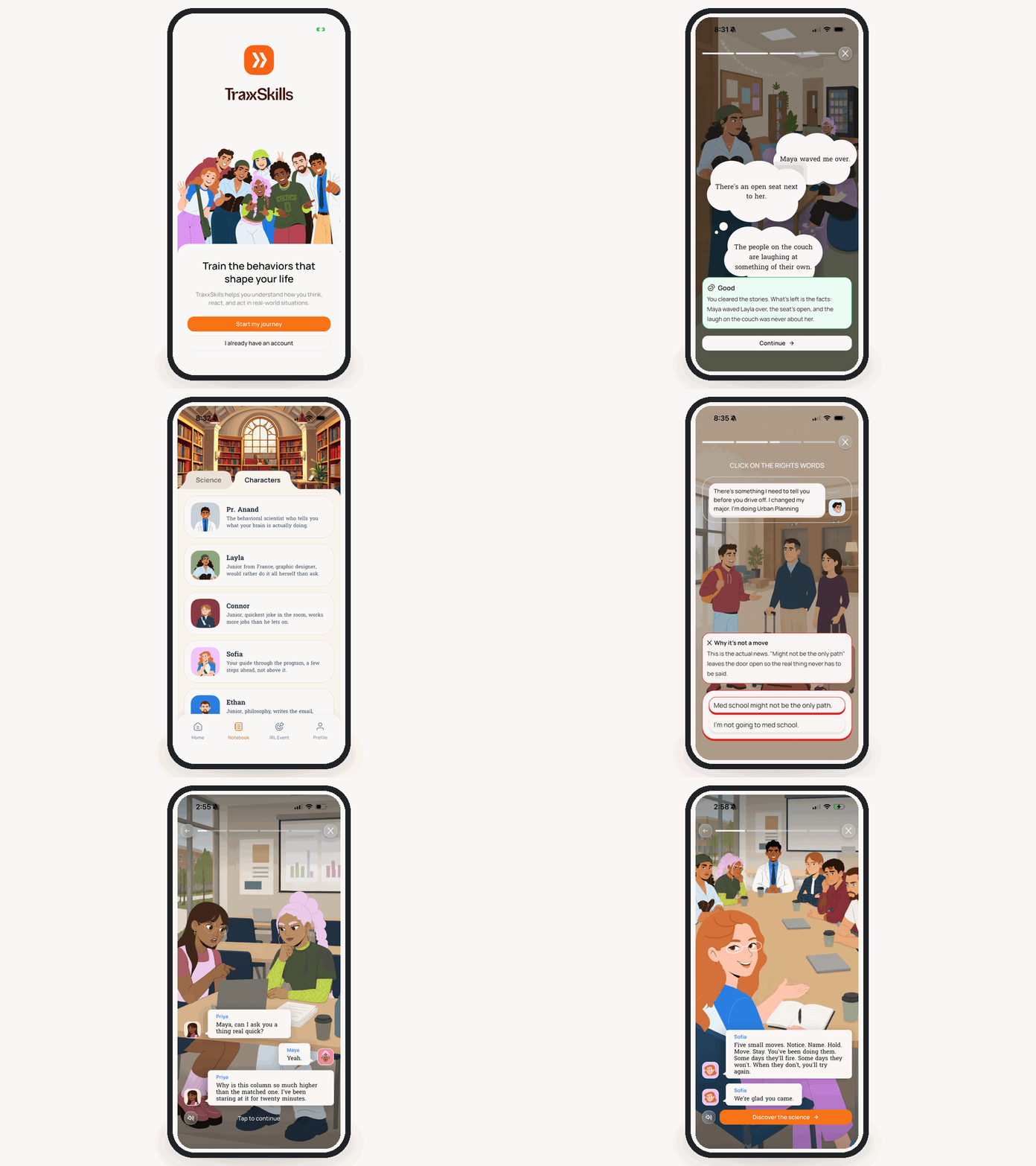
Behavior isn't taught.
It's built.
A student can explain how to recover from a setback and still not recover from one. Five rules separate the two.
Understanding isn't doing.
Every student already knows they should start the assignment earlier. Knowing has never once been the missing part.
One skill at a time.
A lesson works on one thing. A student working on everything at once changes nothing.
Spaced, not crammed.
One lesson a week for a semester. A weekend workshop produces a feeling that's gone by Tuesday.
Nothing is graded.
Completing it earns a credit. Nothing inside it earns a score, so a student stops performing and starts telling the truth.
Every skill gets a name.
A student can't reach for something they can't name. Every lesson ends with its tool that they call forever use.

A lesson has one job.
Move one skill from understood to used.
Roughly fifteen minutes, one lesson a week, across two semesters.
The scene
The week's skill shows up in a moment a student would recognize from their own week, so they meet the problem before they're handed the fix.

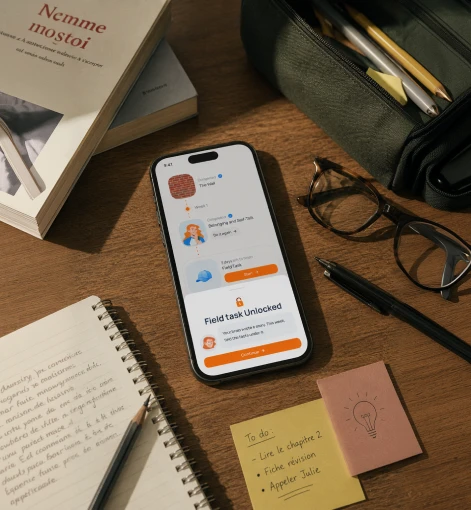
The field task
One real action that week, in their own life, with real consequences, because a skill only counts once it works outside the app.
The practice
The student plays through the scene from the opening, solving the problem the character couldn't. A few questions after it confirm what they just did and why it worked.
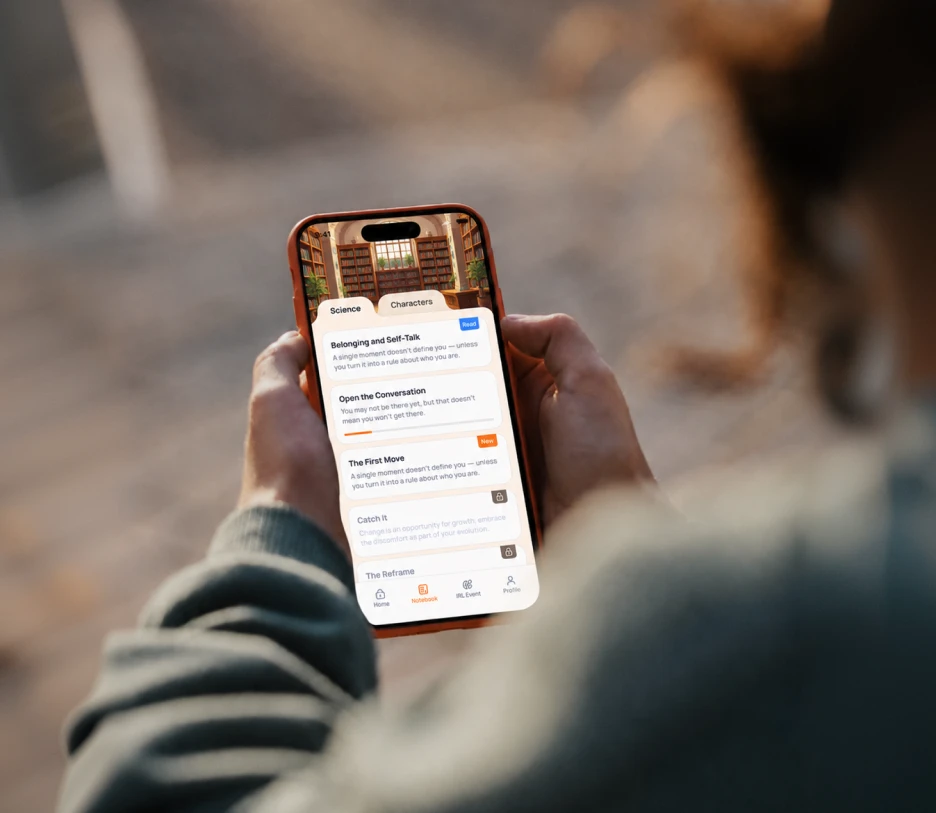
The science
The Professor explains what happens in the brain that makes the moment hard, so it stops reading as a personal failing. Then she names the tool in plain words.
Nothing transfers until it happens for real.
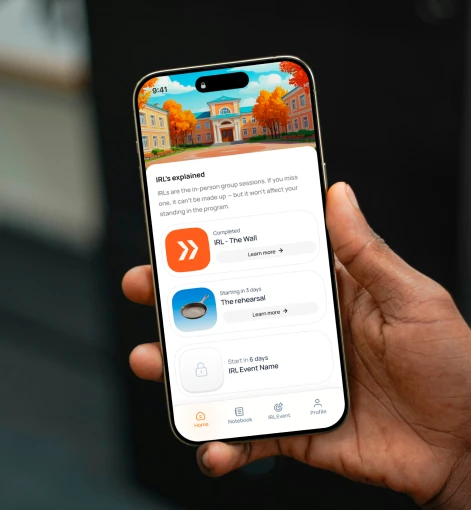
Several times across the program, students put the phone down and do it together, in front of other people, in a setting they'd have signed up for anyway.

Cook a full meal against a clock.
Small teams, one kitchen, a fixed time, and a missing ingredient.

Perform live, without a script.
A theatre troupe trains the students, then hands them a scene they've never seen.

Make something by hand and sell it to strangers.
Students build something in a day and set up a table in public.

Paint a wall the whole campus will see.
An artist works with them on a mural that stays up after they're gone.

Build something the campus keeps.
A carpenter helps them build a take-a-book stall and install it on campus.


No behavioral buzzwords. A method that transfers.
The program is built from published behavioral science, from how behavior actually forms and holds, rather than decorated with research after the fact. Everything below is sourced.
The sequence is the product
Seven phases, and the order is not negotiable. You can't teach recovery to a student who hasn't learned to start, or navigation to one who can't hold steady first. Each phase is the floor the next stands on, which is why most programs fail. They hand students the top of the ladder in week one.

The executive brain matures last
The prefrontal cortex runs the functions at the heart of the program, including planning, impulse control, and follow-through. It is the last region of the brain to mature, still refining into the mid-twenties.

A gap that explains the behavior
Emotion and reward come online years earlier. A fully capable eighteen-year-old can know the right move and still not make it under pressure.

The window that goes unused
These skills form most reliably between eighteen and twenty-five, and most students pass those years with no structured support.
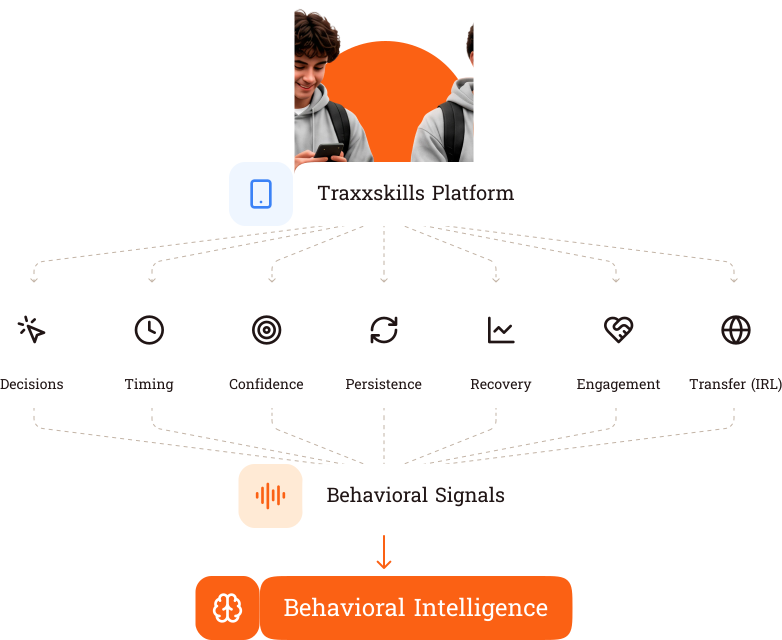
Every student interaction becomes behavioral data.
TraxxSkills continuously captures behavioral evidence across the learning journey, transforming everyday interaction into a proprietary behavioral dataset
Runs alongside everything you already do.
TraxxSkills runs underneath advising, tutoring, and early alerts, building the skills those services already expect a student to have. It competes with nothing on your org chart.
Three things that make it easy to say yes
Light on faculty time
One instructor of record, no lecture hours, no course to design. Students run it on their phones.
Nothing gets replaced
It integrates with your student-success infrastructure and takes nothing off your existing roster.
Nothing to build
The program, the app, and the instructors for every live event arrive complete. You license and launch.
Bring this to your students.
TraxxSkills opens to universities in January 2027. In pilot now at the University of New Haven, Connecticut.
- Six-year completion rate is 61.1% (fall 2019 cohort) — roughly 39% do not graduate within six years. National Student Clearinghouse Research Center, Yearly Progress and Completion (Dec. 2025); corroborated by NCES, Digest of Education Statistics.
- Attrition spans the full ability range; non-completion is not concentrated among low performers. NSC Research Center completion data; Vincent Tinto, Leaving College (University of Chicago Press).
- Behavioral and belonging factors drive early departure. Lumina Foundation / Gallup, State of Higher Education; Walton & Cohen (belonging research); Tinto.
- Net tuition revenue per student, after discounting (avg. ~56–57% at private nonprofits). NACUBO Tuition Discounting Study; College Board, Trends in College Pricing; IPEDS.
- Cost to replace one student — recruitment ($500–$2,800) plus revenue lost before backfill. Ruffalo Noel Levitz Recruitment Report; IPEDS financial metrics.
- Skill durability requires spaced, effortful practice under realistic conditions. Behavioral-science literature on stress inoculation, deliberate practice, and transfer of learning.
- Prefrontal cortex maturation continues into the mid-twenties, later than the limbic (emotion/reward) system. Established developmental-neuroscience finding; see e.g. Casey, Giedd & Thomas on adolescent brain development.